Introduction
Many people I knew were talking about the new age we were in. Everything has changed, nothing is the same—a growing sentiment. Lessons would be learned, surely.
The Covid-19 pandemic taught me the tenacity of death, its ability to diversify, to permeate, to placate. Simultaneously, new, more spectacular and titillating ways of documenting a destabilizing world continued to emerge. There was a buzz in the air, a buzz that certainly meant these images would be forever engrained into our psyche’s.
Bodies were encased in plastic wrap to be transported—the moment of transition from personhood to objecthood literalized.1 A new anger stirred in many around well-documented state violence. Protests had manifested in response to previous murders at the hands of police, but the George Floyd protests gained global attention. George Floyd’s image was ubiquitous. Social media was thought to be forming a new kind of political consciousness.
Black Square by Russian painter Kasimir Malevich, has been described as “radically non-representational”.2 To me, the painting is an attempt at the impossible. The painting is an attempt at removing form in its entirety and depicting that which is left. And when I look at the sole black square I can’t help but feel the work is empty. I feel like I can move deeper and deeper into the image. The image though, is also a square on a canvas—so pedestrian it’s frankly comical to say out loud.
The Instagram black square was a cultural phenomenon, I learned about after the fact. In response to the killing of George Floyd, and racisms lingering presence in American life generally, the idea for Blackout Tuesday has been attributed to music executives Jamila Thomas and Brianna Agyemang. It was meant to be a day where people forgo “normal business operations.” ViacomCBS Networks went dark for a hole 8 minutes and 48 seconds to honor George Floyd, bravely sacrificing sacred run-time.3 The language around the event was telling. The day was meant to be “observed.” People were taking part in a ceremony.

Many users on Instagram noted how the campaign created a kind of feedback loop. On Blackout Tuesday when people searched the “BLM” hashtag, helpful resources were buried beneath a sea of black squares. The square was inescapable.
And of course there were the other images. The images unable to be taken. The images taken but not seen. The images seen by just a few. The images in little pamphlets handed out and hung on the fridge. Images cut into lockets and turned into phone screen savers. Images printed onto t-shirts, candles, mugs, and hats—all with little branded watermarks. And the images in our heads, the images we can smell, and taste, and hear. The images that appear when we surrender our waking mind to the night and close our eyes.
This time brought forth a new proliferation of images of death, but also a new kind of erasure. Writing now, in the present of 2025, the memory of that time is floating away from my mind. I am trying to stop that from happening.
To forget something is for something to be lost from inside of you. To know that you have forgotten something requires some form of remembrance. If forgetting is slipping off the edge of a cliff sometimes remembering is the cold sea at the bottom. Forgetting is an optical illusion—once you step away and squint your eyes, the image pops back into view. Forgetting shatters the idea that our brains work like computers, clocks—what have you. Forgetting can be a pleasant lull, like a short nap. But forgetting important things, to me feels like memories drowning in time, slowly bobbing away, into the fog.
Many people thought that these images of death and protest would function as the new permanent background to life: a new solemn reminder to strive for a collective future. So many of these images are now buried in an empty black sea.
Discovered underneath Kasimir’s Black Square was a work from French “humorist” Alphonse Allais, “Combat de Nègres dans une cave pendant la nuit” (“Negroes Fighting in a Cellar at Night”). The work underneath the work was a black joke made in 1897.4 Black people lost in the void of a dark room. The black square has repeated history.
Simply Not
For many artists I know, COVID-19 was passé long before the end of the first year of the pandemic. And granted, the number of zoom digital-VR-AR-walkthrough-mobile-web-based shows had a particular flavor that left a bad aftertaste. And I think some people felt it was a little crass to think about art-making at all during that time.
There was a pretty clear paradigm shift about two and a half years in. A kind of moral fatigue had dampened the energy people had for public health precautions. The CDC had begun downplaying the severity of infection rates. Soon, self-appointed health advocates crawled back into the shadows, secretly happy to pretend we weren’t in a new age of politically motivated health crises. This was the background to some very lonely years.
I could feel myself withdraw from public space, mostly out of necessity. I was one of the first people to get a Pfizer vaccine after medical professionals. I am a two-time transplant recipient, have chronic kidney disease, and didn’t like people very much at the time. In between looking for a new job and responding to “oh, what can I do” messages, I couldn’t help but feel a deep malaise. To quote John Green’s Everything is Tuberculosis,
“Death is natural…None of us actually wants to live in a natural world. “5
I can’t help but see this reflected in the stuff people left around the city during those early COVID years. There was a sense that people were disappearing, and the remnants folks left behind felt like a survival tactic—maybe there was something important about that old t-shirt left on the sidewalk.
I certainly felt I was becoming more invisible. As described in the book Health Communism,
“More than a thing, and so often difficult or impossible to describe, health becomes defined by the things it is not. Non-cancerous, dis-abled—as though the purest state of health is to simply not exist.”6
As the world started to realize that herd immunity was harder to achieve than first anticipated7, (and commercial pressure pushed legislators to cease COVID precautions) many like myself learned that the true national public health strategy was one of obscurity—of collective amnesia, and gradual abandonment. I felt (and often still feel) myself being pushed from public life. Pushed into said obscurity.
Walking
“I am both angry and afraid. Angry that life can still take such an ugly and familiar form, and afraid that death will catch me before I get home.”
–John Francis, Planetwalker 8
Walking around while the city streets were mostly quiet was nice. Sure, I missed the life-bringing meetups with my close friends, but I’ve always found the chitter-chatter of strangers tedious at best. I’ve been told too many times that someone tried and failed to get my attention deep into a walk.
For a while, I became fascinated by the story of John Francis, the Planetwalker. After the 1971 San Francisco oil spill, he spent twenty-two years walking across the United States as an environmental activist. White Spaces Black Faces author, Carlyn Finney, notes that Francis spent seventeen of those walking years without speaking.9
Maybe I wanted to bring more meaning to the walks I had been taking. I understood the desire to tackle a problem that feels insurmountable. And even more so, I understood the desire to stop talking. Stop adding to the collective noise, the media death race, the audio-visual entropy that feels ever-expanding, or collapsing.
Earthship
“…there is such a global interest in these, and one of the things they’re saying is that these are great for rural areas, but they wouldn’t work in an urban circumstance. So we’re trying to demonstrate that you can do two- and three-story row housing using these same concepts, and they’ll work every bit as [inaudible].”
—Michael Reynold 10
For the uninitiated, earthships are an architectural design created by architect Michael Reynolds. They are meant to be totally self-sustaining. They utilize recycled and earthen materials for building and are usually built into hillsides for climate control. One side has angled windows to allow for temperature regulation and create an ideal space for indoor plants. The roof captures rainwater for cleaning, drinking, and plants. There can be a central hearth for heating the home, and solar generators are meant to power the structures.
This is a very particular way of addressing environmental impact. I think at first, I was enamored by the idea of earthships, but later felt there was a kind of irony to their philosophy. For one, the design usually requires a lot of land. You are meant to homestead on your property, raise plants, store water, have unobstructed light, and build directly into a hillside. Zoning laws in the United States force people to build alternative-living structures in wide, barren landscapes. All of this makes building an earthship inaccessible to most people. I personally feel that earthships are a deeply individualist way of addressing the environmental crisis.
All of this made me especially curious when I learned that someone was trying to build an earthship close to where I lived in Philadelphia. Philly has dozens of empty lots. Around 2009, local activist Rashida Ali-Campbell had the idea to create the first earthship in an urban space. Rashida envisioned this Urban Earthship as an opportunity to create a much-needed community center providing free healthy food and other resources. Unfortunately, the project was delayed for years. This was due to litigation over who had ownership of the empty lot on which the earthship was to be built. 11 Eventually Rashida regained access to the land, but a lot of time was lost. The project was meant to be finished in 2021, but as I was walking past the site around that time, I saw it was mostly overgrown grass.
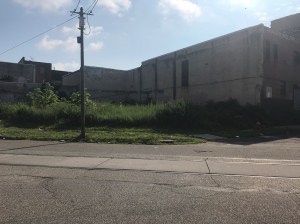
I reached out to Rashida about the project and whether it was abandoned. At first, it seemed we might get to have a conversation about her earthship. I was trying to find time between school and prepping for my wife’s upcoming surgery. After trying to coordinate a time to chat, I was left with this parting message.
“Peace Julian,
Amen, take care of your wife. She is your blessing. We will chat very soon, I pray for her recovery and good health. I pray for her strength and peace. I am a believer in Christ. I pray in Jesus name. I hope i do not offend.
In love,
Rashida
Love Heals All Things“
I don’t blame Rashida for not wanting to talk more about the project. The Urban Earthship seems to have had a lot of initial energy and support behind it. However, all of that was cruelly taken from her. She is someone who worked so hard to make a permanent impact. Looking at early reports on the project, I think she did. But she didn’t get the earthship she wanted. There are all these remnants of the project that remain, like the foundation of the pounded tires, the 3D renders, and the tall grass waving in the hot Philly air.
Remnants
Walking around Philadelphia is a story about remnants and about trash. Even prior to the recent labor strike of city workers, piles of garbage have long been a fixture of the Philadelphia landscape.
The nickname “Filthadelphia” isn’t uncommon. Besides all the trash, like many large cities, “Free Stuff” boxes are laid everywhere—conveniently close to the proper trash piles. People are constantly leaving broken and soiled goods out on the sidewalk for passersby to peruse. A rice cooker with the ground prong melted off the plug, a cow-patterned clay mug, a bookshelf, and a broken Ikea mirror: these have all come and gone from my wife and I’s apartment.
Much of our trash issue comes from a lack of infrastructure around trash pickup. We don’t have standardized bins or uniform pickup areas. Most things are picked up manually, leading to people having to put naked trash bags on the sidewalk. This arrangement makes the trash easily accessible for the sanitation workers and rats alike. I like Philly, and I like that you can probably furnish an entire apartment after a few good walks around the city. But it can be tough to see how often people leave things behind in the city.
Before living here, I would occasionally see the odd cigarette butt being thrown out of a car window, but here I see more folks tossing trash unabashedly. There are several techniques I’ve seen emerge from the industrious litterer. One tactic is to use the rhythm of bird droppings. The tosser holds the item while in motion and subtly lets go mid-stride (cue the whistling). Another strategy is the “put it on the shelf” method, where someone rests an item on a ledge, waits a bit, and then moves on. And then there are just some people who fling whatever wherever.
It’s hard to understand why people leave their stuff in this way. Outside of the desire to be rid of a minor inconvenience, part of me believes littering is about making a mark, leaving a little impression. No one can deny that someone was there when they find a soggy coffee cup or a pile of used scratch-off tickets. People can’t help but be acknowledged.
The past few years have been years of great loss. Early Covid deaths rang loud in the public consciousness. Images of doctors in full face shields, bodies being stacked at nursing homes…The images were vivid and undeniable. For many, the hardest part was that prevention required isolation. I remember having a hypertensive attack and needing to go to the ER. The waiting area was packed, and no visitors were allowed in the building. My wife, who is, in fact, my blessing, waited all night outside the hospital coffee shop.
These days, getting up to date information on infection rates is becoming more difficult. Many states have ended reporting. There was never a robust system of self-reporting for at home COVID test takers. Masking as an issue became a microcosm for the slow erosion of public health in America. We are left with the remnants of a health system. And often, I do things from a distance because of that.
On one of my walks, I came across a makeshift monument. A grouping of white flags was placed in a local park. It was almost like a small cemetery. Each flag represented a Palestinian slain in the current genocide. This display joined a long history of impromptu memorials in Philadelphia.
There was something bleakly fitting about how makeshift the presentation was. There was also printed material describing the genocide and what the project meant. In an act of brutal symmetry, the scrappy Palestinian memorial was swiftly removed from the park by the city.
Scrap
My things give me great anxiety. I am worried they will trap me.
I started taking photographs in large part because paints are amorphous and messy. I have deep fear of food touching my face and paint is maybe too close in texture to mayo.
I also don’t Iike taking up so much space. Walking around with my DSLR meant that I didn’t have to collect huge varieties of paint, with its mediums, and oils, and brushes, and sponges, and canvases, and boards, and gesso, and gouache, and smocks, and cups, and paint palettes, and palette knives, and gloves. I still go through phases of wanting to take up as little space as possible.
My cat can attest that every few weeks or so, I rummage through everything I own, looking for stuff that upsets me. My older sister can attest that I threw away her high school scrapbook because it took up precious empty space in my new bedroom (her old bedroom). When she confronted me and asked why I threw it away, I protested, saying she only cared now that it was gone (a cruel thing to say).
But to be fair, I needed to make room for the paintings I was working on. They were giant. I was in high school, taking wooden boards the size of tabletops and painting on them for class. When I inevitably tried to get rid of them, I learned the rules for large trash pickup in Indianapolis. And as many moms do, mine prefers to keep and collect my old artwork.
She likes to remind me of it: “Why don’t you make stuff like that anymore? Why don’t you draw? Do you want supplies? At least if you’re not gonna draw on paper, can we get you an iPad, so you can keep sketching?”
Painting reminds me of younger, sadder version of myself.
I try to make things, sometimes big things, but I always feel weighed down by them, burdened by them.
I thought digital photography would bring a resolution to this issue in my life, but unfortunately, things prevail. I got cameras, and lenses, and ND filters, and SD cards, and Micro SD cards, and tripods, and monopods, and gimbals, and paper, and frames. Just thinking about it makes me wanna create e-waste.
I mostly take photos with my phone now, and I mostly don’t take any photos, and I mostly just write about what I would have tried to take photos of.
I get asked sometimes if I have a studio space—and that always irks me. I didn’t realize it at first, but I find studios to be stifling. When a studio is empty, most people are inclined to fill it. Disgusting.
Wax
What used to be an array of cigarette butts and food packaging littering the ground is now also so many surgical masks. In a lot of ways, what we find on the street is a symptom of what’s going on in our worlds. Mountains of broken Wayfair futons litter the streets during college student move-out week.
Empty husks of pilfered bicycles are securely locked to public racks. The sidewalk is covered in the carcasses of dead spotted lantern flies (the invasive species the public has been informed to stomp on sight). And there are a lot of masks.
Walking through Philadelphia, you’ll see the personal memorials that dot the city—sweet murals dedicated to loved ones, candles, flowers, bears, notes, wreaths, and pictures.
It’s lovely how permanent these precarious things are. Certainly, candle wax will last for a few months if left unlit, and the Catholic glass candle holders can last for years. I’ve seen balloons lose their color before disintegrating. Most children’s toys will be here much longer than I will.
There is a street in the Bay Area that I think about a lot. Dozens of shoes hang from the powerlines. The shoes cover the whole length of the block. They are like birds perched together. It’s probably just a neighborhood tradition to throw shoes you’ve outgrown over the power lines, but for some reason, I like the idea that there is something else to it.
What I appreciate about these ad hoc memorials is that the public is often encouraged to add to them. People bring their interpretations, their hopes, their relationships to these scenes. Taking the photos in this book gave me a chance to interact with these types of memorials.
Plans
I was talking with my father-in-law about end-of-life plans.
We were walking in the Woodlands Cemetery, a local cemetery that also functions as a park. My wife’s maternal grandmother had passed away recently, and the setting just prompted such a conversation. I think we talked about different kinds of burials. I care less about how my body enters the ground, and more about my tombstone. It’s hard for me to imagine being represented by a bit of rock with my name on it. I kind of like the idea of a giant book—a book with every memory a person could conjure about me. Everyone should have a book. Or maybe I should have the things I used the most on top of my grave: my eyeglasses, iPhone 13, and an Epson short throw projector/smart TV. Or maybe tombstones should have questions on them that passersby could answer: “Have you cured West Nile virus?” “Was my son the person I hoped he’d be?”
When I think of death I think of oblivion. Oblivion is truly terrifying. Oblivion is an ultimate erasure. Oblivion is more nothing than I can understand. Obscurity is being forgotten. Obscurity might be the closest we can come to understanding what oblivion feels like. We can’t do anything about oblivion, but we fight obscurity every day. And I think people do all sorts of things to say, “I was here, I am here.”
Sources
- Irwanda, Joshua, “A Covid-19 Victim Becomes a Modern Mummy.”, National Geographic Special issue: The Year in Pictures, 2021, 80-81.
- Sandra Gonzalez, “Music Industry Leaders Vow to Pause Business for a Day in Observation of Blackout Tuesday,” CNN, January 2, 2020, accessed April 10, 2025, https://www.cnn.com/2020/06/01/entertainment/blackout-tuesday-the-show-must-be-paused/index.html.
- Philip Shaw, “Kasimir Malevich’S Black Square,” January 1, 2013, https://www.tate.org.uk/art/research-publications/the-sublime/philip-shaw-kasimir-malevichs-black-square-r1141459.
- Carey Dunne and Carey Dunne, “Art Historians Find Racist Joke Hidden Under Malevich’S “Black Square”,” Hyperallergic, November 17, 2015, https://hyperallergic.com/253361/art-historian-finds-racist-joke-hidden-under-malevichs-black-square/.
- Green, John. Everything Is Tuberculosis: The History and Persistence of Our Deadliest Infection. Random House, 2025. 53.
- Adler-Bolton, Beatrice, and Artie Vierkant. Health Communism. Verso Books, 2025, Xi.
- Aschwanden, Christie. “Five Reasons Why COVID Herd Immunity Is Probably Impossible.” Nature 591, no. 7851 (March 18, 2021): 520–22. https://doi.org/10.1038/d41586-021-00728
- Francis, John. “Planet Walker: 22 Years Walking. 17 years of Silence.” National Geographic, 2008, 62
- Finney, Carolyn. Black Faces, White Spaces: Reimagining the Relationship of African Americans to the Great Outdoors. UNC Press Books, 2014,100.
- Democracy Now, ““Earthship Biotecture”: Renegade New Mexico Architect’s Radical Approach to Sustainable Living,” Democracy Now!, October 11, 2012, https://www.democracynow.org/2012/10/11/earthship_biotecture_renegade_new_mexico_architects.
- Chinn, Hannah. “Meet the Woman Turning a West Philly Lot Into an ‘Earthship’ Made of Tires and Glass Bottles.” WHYY, October 10, 2019. https://whyy.org/articles/meet-the-woman-turning-a-west-philly-lot-into-an-earthship-made-of-tires-and-glass-bottles/.
 Julian Harper